
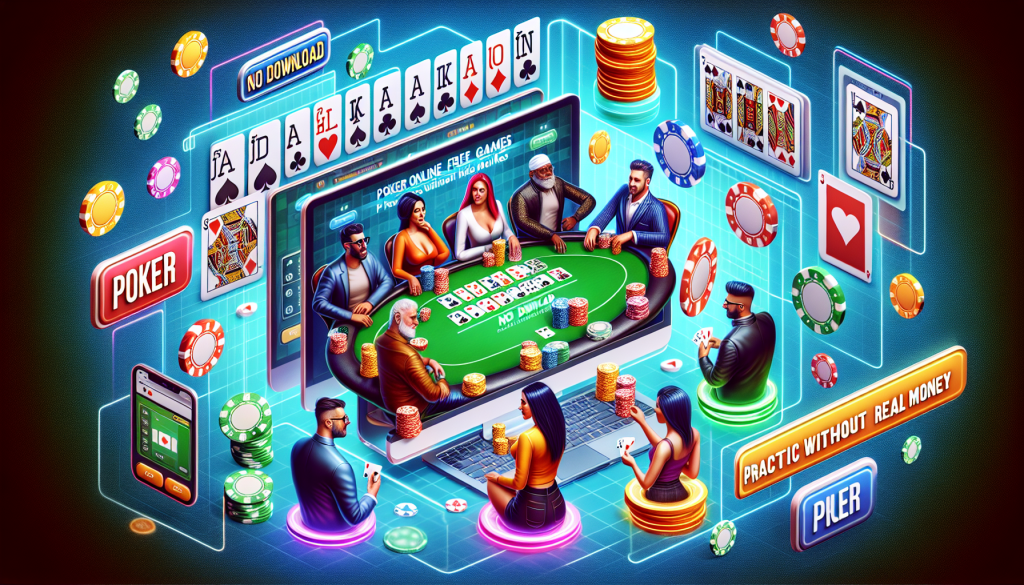
Poker Online Free Games No Download: Practice Without Real Money
If you’re curious about poker but don’t want to risk real money, you’re not alone. Many players start with poker online free games no download options to learn, refine strategies, and build confidence before ever placing a real-money bet. No-download versions let you dive straight into action from a browser or a mobile device without installing dedicated software. This article explores what “poker online free games no download” means, why they’re valuable for practice, where to find them, and how to practice effectively without risking money.
What “no download” poker really means
No-download poker refers to games that run directly in your web browser or via a lightweight, browser-based app. You don’t need to install a heavy client on your computer or device. In many cases, these platforms use HTML5 or WebGL technology to deliver a smooth, responsive experience across desktops, tablets, and smartphones. You can jump into a table in seconds, and you can switch devices without worrying about syncing software or files.
Key differences between no-download and downloadable options include:
– Convenience: No download means instant access from any device with a modern browser. No updates, no storage concerns, and no compatibility issues.
– Accessibility: You can try poker on work or school devices (within policy guidelines) as long as you have internet access, which lowers barriers to entry.
– Features: While many no-download platforms offer robust features like multi-table play and chat, some advanced options (like certain hand-history databases or external tracking tools) may be limited compared to downloadable clients.
– Data usage and performance: Browser-based games can be responsive but may demand a steady internet connection. In contrast, downloadable clients can sometimes leverage more system resources for smoother performance on lower-end devices.
Why practice with free play money matters
The appeal of free-to-play, no-money poker is not about chasing winnings; it’s about learning the game with zero financial risk. Here are the main benefits:
– Learn the rules and structure: If you’re new to poker, you’ll quickly pick up hand rankings, betting rounds, pot odds, and position concepts without worrying about losses.
– Build discipline and patience: Free games let you practice core skills like bankroll management, stake awareness, and emotional control in a no-pressure setting.
– Test strategies risk-free: Try different styles—tight-aggressive, loose-aggressive, or conservative approaches—to see what feels natural and yields consistent results.
– Practice postflop play and hand-reading: By reviewing your decisions after hands, you can improve your ability to read ranges, assess bet sizing, and recognize plays that don’t work for you.
– Access learning resources: Many free platforms pair play money with tutorials, guided practice, or hand-history reviews that accelerate learning.
Types of free poker games you’ll encounter online
– Play money cash games: The most common form. Tables use virtual chips instead of real money, so you can practice betting, raising, calling, and folding without any risk.
– Free-roll tournaments: Special events with no entry fee and no real-money prize pool. These are great for practicing tournament-style thinking and learning stack management.
– Sit-and-go (SNG) free games: Short, single-table tournaments that resemble the early stages of a real tournament. They’re excellent for honing quick decision-making in a compressed format.
– Social/promo games: Some platforms offer social features and promotional freerolls, sometimes with limited markets or exposure to real-money play in the future. These can be good for practicing in a social environment with fellow beginners.
– Practice modes and training rooms: Several sites provide guided practice rooms with built-in coaching tips, hand analysis tools, and suggested lines for particular situations.
How to find reliable free, no-download poker sites
– Look for reputable operators: Start with well-known networks that offer play money options in a secure environment. Even if you’re not playing for real money, you want fair play and good customer support.
– Check regulation and RNG certification: Reputable sites publish information about fair RNG (random number generator) testing and licensing. This can give you confidence that play money outcomes are legitimate and not rigged.
– Read user reviews and privacy policies: Ensure the site respects your privacy and doesn’t require unnecessary data collection or intrusive permissions.
– Verify device compatibility: Ensure the site supports your device and browser, delivering a smooth experience without downloads.
– Try multiple platforms: It’s fine to experiment with a few sites to find the interface, table atmosphere, and learning tools that suit you best.
Practical tips for practicing effectively
– Set specific learning goals: Decide what you want to improve (pretend play, hand reading, bet sizing, bluff recognition, or postflop awareness) and measure your progress.
– Define a practice schedule: Short, focused sessions (e.g., 30-60 minutes) are often more effective than long, unfocused marathons. Regular practice helps retention and habit formation.
– Use hand histories for review: After sessions, go through hands where you felt uncertain. Note your line, the pot size, and the equity you had. Try to explain in your own words what you could have done differently.
– Track your decisions, not just your results: In poker, short-term results can be noisy. Track decisions, the quality of your thought process, and the frequency of correct plays rather than only wins and losses.
– Start with low stakes and simple formats: If you gravitate toward tournaments, begin with smaller free-rolls to learn the flow. If you prefer cash-game formats, play low-stakes free money tables to practice steady, disciplined aggression.
– Learn core concepts: Position (acting last improves your information set), pot odds and expected value, ranges, and bet sizing. Practice applying these ideas in your free games to internalize sound decision-making.
– Use training tools: Many free platforms offer built-in tutorials, hand-analysis features, and strategy tips. There are also external free resources—poker forums, YouTube tutorials, and beginner guides—that complement your practice.
– Avoid overreliance on “automatic” moves: Free games provide a safe space to experiment. Resist the urge to memorize a single “trick” move; instead, develop a foundational understanding of why certain lines work in given situations.
– Stay patient and reflective: Improvement in poker is gradual. Keep a learning mindset, celebrate incremental progress, and stay curious about your mistakes.
Balancing fun and learning
Poker is, at its core, a game. Free, no-download options are excellent for lowering the barrier to entry and keeping the experience enjoyable. If you struggle with frustration or tilt during free games, take a short break, review a few hands, or switch to a lighter session before returning with refreshed focus.
Safety and responsible gambling considerations
– Age and legality: Ensure you are of legal gambling age in your jurisdiction. If you’re unsure about local laws or platform suitability, consult a local authority or trusted source.
– Data privacy: Use reputable sites that protect your personal information and encrypt data transmissions.
– No real-money risk, but don’t treat it as “free money”: Even in play money games, you can cultivate habits that transfer to real-money play. Focus on learning and discipline, not on chasing fake winnings.
– Set time and budget boundaries: Free games are risk-free monetarily, but it’s still wise to manage your screen time and avoid compulsive play patterns.
– Be mindful of platform policies: Some social or promotional games have terms that can affect your ability to transfer experience or stats to real-money environments. Read guidelines so you’re not surprised by any restrictions.
From practice to real money: when to switch
Transitioning to real-money play is a personal decision that should be grounded in confidence, discipline, and financial readiness. Consider these signals:
– Consistent improvement in free play: If your win rates stabilize and you demonstrate solid decision-making across multiple formats, you’ve earned a stronger foundation.
– Shrinking variance: If you’ve learned to manage swingy outcomes and maintain a reasonable win rate, you’re less likely to be derailed by short-term runouts.
– Budget readiness: Determine a dedicated bankroll you can lose without affecting your daily finances. Even in real-money games, start with low-stakes tables to minimize risk while you adjust to real-money dynamics.
– Comfort with strategy: If you feel comfortable adjusting ranges, bet sizes, and lines in response to table texture and opponents, you’re closer to a sane transition.
A practical step-by-step plan to begin
1) Pick one or two reputable no-download sites that offer free play money and beginner-friendly tutorials.
2) Create a basic practice plan: 3-5 sessions per week, 30-60 minutes each, with a clear learning objective per session.
3) Start with cash-game free money or beginner-friendly formats to build a solid foundation.
4) After each session, review at least one or two hands that felt tricky. Write down your rationale and seek alternative lines from trusted sources.
5) Track progress over a few weeks, focusing on decision quality and consistency rather than raw winnings in play money.
6) Introduce occasional free-rolls or light tournaments to simulate real-time pressure and scheduling, while continuing to study and review hands.
7) When you’re ready, taper your free-play usage and begin cautious real-money exploration on regulated platforms with low stakes, maintaining strict bankroll discipline and responsible gambling practices.
Common questions players ask about poker free games online
– Are play-money games rigged to trick you into depositing later? Reputable platforms maintain fair RNGs and transparency. If a site seems dubious or makes unrealistic claims, move on and choose a trusted operator.
– Can I learn real-money strategies on free games? Yes. The fundamentals—position, ranges, bet sizing, and pot odds—translate well. The main difference is the emotional and financial risk that comes with real money.
– Do I need an app to play poker online for free? Not necessarily. No-download versions run in your browser, so you can start playing quickly. Some platforms also offer lightweight apps, but these are optional.
– Is it possible to improve with limited free resources? Absolutely. Combine free games with free tutorials, hand-history reviews, and practice routines to maximize learning without spending a dime.
– When should I stop practicing and start playing for real money? Once you’ve established consistent, quality decision-making, feel confident in your strategy, and can manage a bankroll, you can start exploring real-money options. Begin with micro-stakes and always adhere to responsible gambling guidelines.
The value proposition of “poker online free games no download” for beginners
The core appeal is accessibility. Anyone with a modern browser can start practicing within minutes, without the burden of downloads, installations, or financial risk. For learners, free games provide a safe sandbox to experiment with strategies, test new ideas, and build confidence. For busy players, the browser-based format fits into commuting moments, lunch breaks, or quick study sessions. For educators and learners, the combination of free play and coaching resources can form a practical pathway from curiosity to competence.
Closing thoughts
Poker is a game of skill, psychology, and careful decision-making. Free, no-download poker options offer a practical, low-stress way to learn and improve before you ever wager real money. They let you understand the flow of hands, the importance of position, and the impact of bet sizing without the financial stakes that accompany real-money play. By approaching these games with intention—defining goals, reviewing hands, tracking progress, and gradually introducing real-money play as your skills mature—you’ll build a strong foundation that translates to more confident, strategic decision-making at the table.
If you’re ready to start, seek a reputable browser-based platform that offers free play money and an intuitive learning environment. Create a plan, commit to regular practice, and keep your focus on knowledge and skill development. Remember: the goal is steady improvement and safe, responsible enjoyment. Free poker games are a stepping stone, not the destination, and with the right mindset, you can progress from curious beginner to confident, capable player—whether you’re playing for fun or testing the waters of real-money poker in the future.